Dear Congressman Murtha
Dear Congressman Murtha:
With great deference I commend your loyal service to the United States of America during your active duty in the war in Southeast Asia. Truly you governed yourself with nobility emboldened in a passion worthy of true American patriotism. America salutes you for caring during a time when many did not.
And yet allegiant service does not grant one immunity from respectful criticism, inoculation from fair-minded dissent. Just as an experienced doctor is not sealed from malpractice, neither should a decorated Congressman be protected from rational discord. Medically speaking, sir, I believe in this case you diagnosed a benign tumor as malignant.
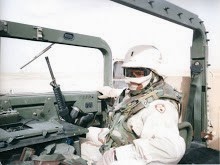
I am familiar with the theatre of warfare, having served tours of duty in Operation Desert Storm and Operation Iraqi Freedom. My duties as a First Lieutenant brought me nose-to-nose with all that combat entails, all things worthwhile and all things somber. I know what it is to sit with colleagues after a hard day's work and commemorate about the good we had done, the liberties we helped propagate. And I know what it is to hold dear brothers in my arms, consoling while shouts of pain and anguish erupted from their throats. Indeed it is a world with which I am intensely acquainted, and one from which I will never shy away.
Congressman, I certainly identify with your desire to end the bloodshed occurring against our brave men and women currently engaged in Iraq. It doesn't take a saint or a scholar to recognize that every soldier's death is a great tragedy, a colossal sorrow. And we can only wonder at the heartbreak each parent must feel upon learning of the death of their beloved son or daughter. Purely tragic. And yet that is the nature of warfare, the reality of defense.
I placed a bumpersticker on my wife's car the other day that reads "Freedom Isn't Free." Platitudinous?
Perhaps. But also unmitigated truth. If ever there was a bull's-eye at which we ought aim, it's the clear and concise understanding that American uniqueness, American exceptionalism rests in her unwavering devotion to the principles of democracy, the proliferation of goodness and fair-play. And here's the punch line: The means by which America extends its generosity and benevolence - the actual advancement of liberty around the world - is often through the sweat, blood, and tears of our valiant members of the United States Armed Forces.
We respect our elected officials and the diplomatic methods they often employ. And certainly we must not underestimate the progress achieved through sincere negotiation and oral debate. And yet only the most fatuous among us would deny that some of the most life-changing victories in the perennial pursuit of egalitarian democracy has come via means of the United States Army, the United States Navy, the United States Air Force, and the United States Marine Corps. This is not conjecture; this is universal truth.
Speaking of bumperstickers, there's a popular one that reads "War Is Not the Answer." Sounds idealistic, but it's pure sophistry, intellectually hollow. For who among us can deny the efficacy of America's military strength in subduing the totalitarian regimes of times gone by, the vanquishing of despots and homicidal tyrants who were unwilling to allow others to live as they would desire? No, that bumpersticker ought read "War Is Sometimes the Answer."
Congressman, in keeping with the tradition of democratic furtherance through military involvement, I was disheartened at your call for what amounts to the immediate withdrawal of our forces from Iraq, the abdication of our current duties within the world's newest democracy. Your calculation is tantamount to "crying uncle" at a time when the people of Iraq need us most. Their democratically elected government exists in an embryonic state, requiring the support and defense from the very nation that initiated its newfound freedoms. It is unconscionable that we would introduce the people of Iraq to a new form of government only to bail out on them in their nascent condition. It would not speak well of our commitment to democracy.
And consider what would occur within the hearts of the malevolent should America turn and retreat. The invigoration and emboldening that would grip the morbid psyches of the Islamic fascists who seek to deny the basic liberties necessary for a contemporary, functioning democracy to succeed. Talk about shots in the arm, these Enemies of Democracy would take every advantage to reverse the gains prompted by America and her allies in this endeavour of compassion. If the attempt to actualize democracy in Iraq can be called a trial balloon, Al Qaeda and their willing associates would be more than happy to deflate it, needless to
say.
And what of our heroic men and women who lost their lives in this mission to promote democracy in the Middle East, this region in which steel-fisted overlords reign supreme? We hold hands and bow our heads in obeisance to honour our fallen colleagues, knowing they gave the ultimate sacrifice to allow others a little taste of the liberties they were blessed to enjoy. We pay homage to our heroes with our words and our prayers and our tears and our memorials, lifting them Heavenward as the angels of God they are.
And yet would it not be the essence of dishonour, the embodiment of ingratitude, to turn tail and disengage when clearly the work has not been completed? To evacuate with the assignment semifinished?
Congressman Murtha, fleeing Iraq at this critical juncture goes against the grain of everything I was taught when I volunteered to become a member of the US Marine Corps years back. I was told that becoming a soldier meant that we would have obligations, and that these obligations were to be met. I was apprised that our choice to don the uniform differentiated us from the rest of society because our jobs were often life and death. I was told that the people of the world's most powerful nation depended on us to fulfill our duties . . . no excuses . . . no cop-outs . . . no rationalizations . . . no bullshit.
Has the manual changed since my boot camp days, sir?
America's integrity in the eyes of our friends and enemies now rests upon the shoulders of people like you, sir. The decisions emanating from Washington will go a long way in determining whether our country holds firm upon its lofty perch as the world leader and protector of individual liberty and systematic human rights. It's not always good to balance upon a fence, Congressman, but if you must, at least be certain to fall upon the side that places our blessed land in the brightest, most admirable light; a glorious brilliance at which all nations can gaze and declare with certainty that we, the United States of America, have proved worthy of our immense strength and rectitudinous might. Departing Iraq at this moment is antithetical to all we deem necessary in the advancement of this cause, and something in which our detractors will no doubt delight.
You know, I fondly remember during my childhood heading to the beach on warm summer days. My whole family would pile into my dad's truck and we'd blast the radio, stop for some junk food, then head to the ocean. My siblings would go off swimming and my dad and mom sat nearby, listening to a ballgame on the radio. Me? I'd usually hang around the water's edge, using an old pail and shovel to dig up as much sand as I could get my little hands on. Yeah, I knew I was gonna build the best, tallest, finest sandcastle on that whole beach, and I'd go to work shaping and molding and patting and fine-tuning it long into the afternoon.
One day I got a little tired, maybe a little too much sun, so I stopped. I got up and walked on over to my dad, who was looking at some sports magazine, a visor keeping the sun from his eyes. He said "What you up to, boy?" and I told him I had built a sandcastle. I pointed over to it and told him that that one over there was mine, and he lifted his sunglasses to peer at it. At this point I was expecting him to shower me with some praise, some "That's great, boy" compliment.
But no, that didn't happen.
My dad looked at my sandcastle and said, "Well, now, it looks half done . . . why'd you stop?"
I looked back at my dad and whined, "Well, I got tired . . . it's good enough the way it is."
My dad shook his head and said, "Son, always -- always-- finish what you start. Never make excuses, just finish what you start."
Congressman Murtha, my dad was not rich, he was not famous, he certainly was not a United States Congressman. But, sir, with all due respect, I'll take my dad's advice over yours anytime, anywhere.
Sincerely,
First Lieutenant John Thomas Porter, Jr.
posted by Jobu's Blog @ 6:16 PM
0 Comments



0 Comments:
Post a Comment
Subscribe to Post Comments [Atom]
<< Home